
Baseball is known for its precise field dimensions, and one of the most commonly asked questions about the game is:
How many feet is it from home plate to first base?
Whether you’re a player, coach, parent, fan, or building a baseball field, understanding the distance between home plate and first base is essential. This measurement is one of the most important dimensions in baseball because it influences everything from hitting and baserunning to defensive strategy and game pace.
In professional baseball, the distance has remained unchanged for more than a century and is considered one of the defining characteristics of the sport.
This guide explains the official distance from home plate to first base, why that distance matters, how it is measured, and how it differs across youth and amateur baseball leagues.
Quick Answer
The official baseball distance is:
Home Plate to First Base=90 feet
Final Answer
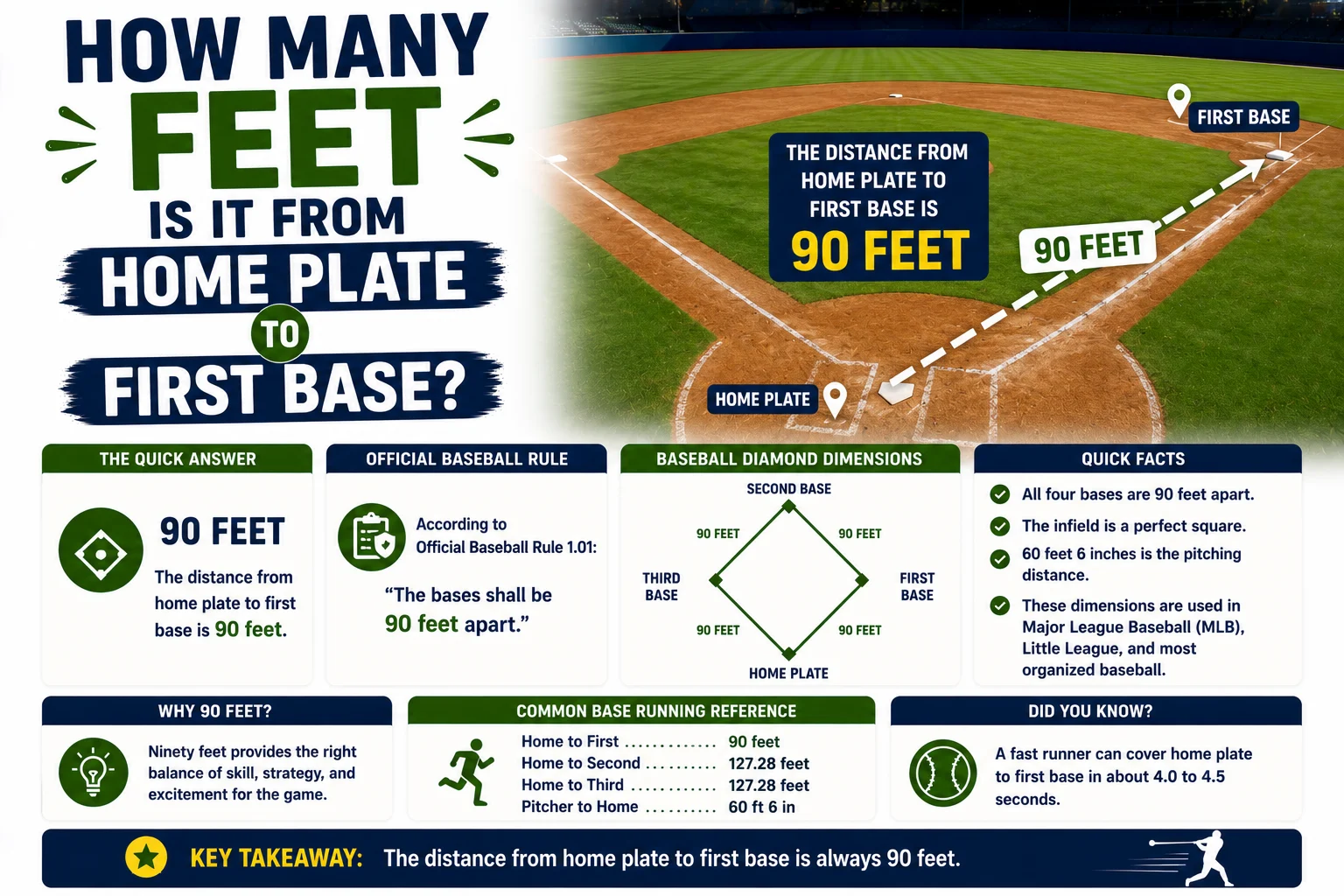
The distance from home plate to first base is 90 feet in Major League Baseball and most adult baseball leagues.
This same distance applies to:
- First base to second base
- Second base to third base
- Third base to home plate
Together they form the baseball diamond.
Understanding the Baseball Diamond
The baseball infield is shaped like a square.
Each side of the square measures:
90 feet
These sides are known as:
- Home plate to first base
- First base to second base
- Second base to third base
- Third base to home plate
Because all four sides are equal, the infield forms a perfect square.
Why Is the Distance 90 Feet?
The 90-foot baseline became standardized in the 19th century.
Early baseball did not have universal field dimensions. Different clubs often played with different field layouts.
As the game became organized, officials determined that:
90 feet provided the ideal balance between offense and defense.
At this distance:
- Hitters have a realistic chance to reach first base
- Fielders have enough time to make plays
- The game remains competitive
The distance has remained unchanged for professional baseball ever since.
Measuring Home Plate to First Base
Many people assume the distance is measured from the center of home plate.
However, official field measurements use specific reference points.
The 90-foot distance is measured:
- From the rear point of home plate
- To the back corner of first base
This ensures consistency across all regulation fields.
Baseball Diamond Geometry
Because the infield is a square:
Each side equals:
90 feet
The total perimeter of the base paths equals:
90×4=360 feet
A complete trip around the bases requires:
360 feet of running
Distance Around the Bases
A player hitting a home run must travel:
90+90+90+90=360 feet
This includes:
- Home to first
- First to second
- Second to third
- Third to home
Distance From Home Plate to Second Base
Many people wonder how far second base is from home plate.
Because the infield is a square, the diagonal is longer than the baseline.
Using the Pythagorean theorem:
d=902+902
The result is:
d≈127.3 feet
So:
Home plate to second base is approximately 127 feet 3⅜ inches.
Why 90 Feet Matters
The 90-foot distance affects nearly every aspect of baseball.
Hitting
Hitters must reach first base before the ball arrives.
Fielding
Infielders must field and throw accurately within a short time frame.
Pitching Strategy
Pitchers adjust their approach based on baserunner speed.
Base Stealing
Runners calculate lead-offs and stolen base attempts based on the 90-foot baseline.
How Long Does It Take to Run 90 Feet?
Professional players often sprint from home to first in:
- 3.9–4.3 seconds for right-handed batters
- Slightly faster for left-handed batters
Elite runners may reach first base even faster.
Left-Handed vs Right-Handed Batters
Left-handed batters enjoy a small advantage.
Because they start closer to first base, they may save:
- A few feet
- A fraction of a second
This can be significant on close plays.
Little League Distances
Youth baseball uses shorter base paths.
Common distances include:
| League | Base Distance |
|---|---|
| Little League (Majors) | 60 feet |
| Intermediate | 70 feet |
| High School | 90 feet |
| MLB | 90 feet |
These shorter distances help younger players compete safely.
High School Baseball Dimensions
Most high school baseball fields use:
90 feet between bases
This prepares players for college and professional baseball.
College Baseball Dimensions
College baseball follows the same standard:
90 foot baselines
The consistency helps maintain player development and competitive balance.
Softball Comparison
Softball fields use shorter baselines.
Common distances include:
- 60 feet
- 65 feet
- 70 feet
depending on league and age level.
This reflects the differences in game speed and field size.
Building a Baseball Field
When constructing a field:
The first step is establishing:
90 foot base paths
Accurate measurements are critical for:
- Fair play
- League compliance
- Player safety
Historical Development of the 90-Foot Baseline
During baseball’s early years, dimensions varied significantly.
By the mid-1800s:
- Organized leagues sought standardization
- 90 feet became the accepted distance
This measurement proved ideal and remains unchanged today.
Strategic Importance of First Base
First base is unique because:
- Runners can overrun it safely
- It is often the most contested base
- Nearly every offensive play involves reaching it
The 90-foot distance creates the tension between:
- Fast runners
- Strong defensive throws
Famous Baseball Records Influenced by the 90-Foot Distance
Many baseball statistics are tied directly to the baseline length:
- Stolen bases
- Infield hits
- Double plays
- Bunting success
The 90-foot measurement influences every one of these outcomes.
Common Misconceptions
Home Plate to First Base Is Not Measured Center-to-Center
Official measurements use specific points on both home plate and first base.
The Distance Is Not Approximate
It is exactly:
90 feet
on regulation baseball fields.
Not All Baseball Leagues Use 90 Feet
Youth leagues often use shorter distances.
Interesting Facts About the 90-Foot Baseline
- It has remained unchanged for more than 150 years.
- Players run approximately 360 feet to complete a home run.
- The distance creates one of the sport’s most important timing challenges.
- Even a few inches can determine whether a runner is safe or out.
FAQs
How many feet is it from home plate to first base?
90 feet
How many feet are between all bases?
90 feet
Each baseline measures 90 feet.
How far is it around all four bases?
360 feet
Do Little League fields use 90 feet?
No. Most Little League fields use shorter baselines, commonly 60 feet.
Why did baseball choose 90 feet?
The distance provides an ideal balance between offensive and defensive play.
Conclusion
So, how many feet is it from home plate to first base?
The answer is:
90 feet.
This distance is one of the most important measurements in baseball and has been the standard for professional and adult leagues for generations. The 90-foot baseline influences hitting, fielding, pitching, base stealing, and virtually every play that occurs on the field. Its carefully balanced length helps make baseball the strategic and competitive game that millions of fans enjoy around the world.