

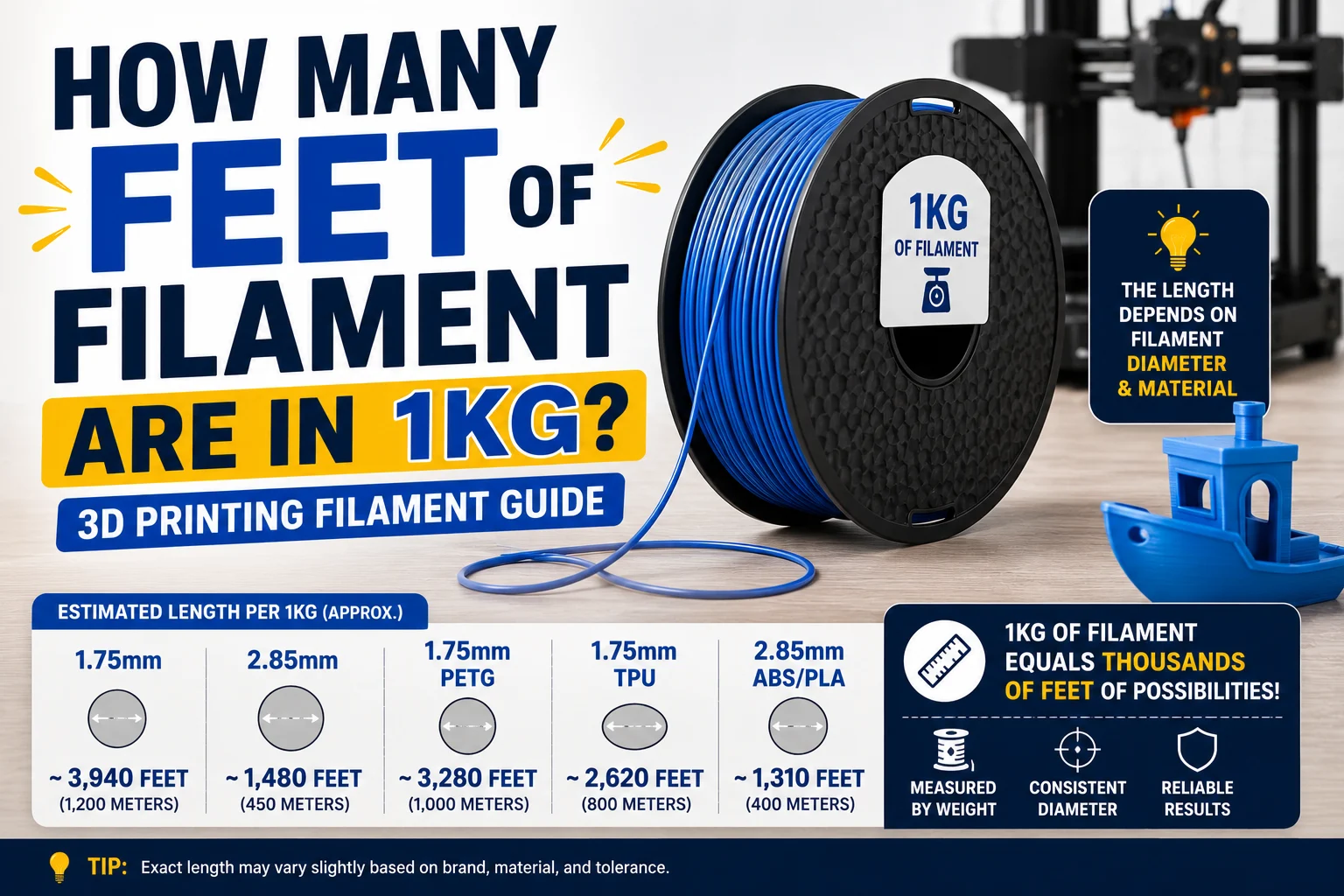
If you are wondering how many feet are in a 1kg spool of filament, the answer depends mainly on:
- Filament diameter
- Material density
- Filament type
For the most common 3D printing filament size:
1.75 mm PLA filament ≈1,080 feet
A standard 1kg spool of:
- PLA
- PETG
- ABS
usually contains roughly:
1,000 to 1,100 feet
of filament.
Understanding filament length helps users:
- Estimate print capacity
- Manage material costs
- Plan large prints
- Compare filament types
In this complete guide, you will learn how filament length is calculated, how different materials affect spool length, and how many prints a 1kg spool can typically produce.
Quick Answer
A typical 1kg spool of:
- 1.75 mm PLA filament
contains approximately:
1,080 feet
For:
- 2.85 mm filament
the length is usually shorter because the filament is thicker.
Why Filament Length Depends on Diameter
Filament diameter directly affects:
- Total spool length
Thicker Filament Uses More Material
Larger diameter filament consumes:
- More plastic per foot
Therefore:
- Thicker filament produces shorter total length for the same weight
Common 3D Printer Filament Sizes
Most 3D printers use one of two standard diameters.
| Filament Diameter | Approximate Length in 1kg |
|---|---|
| 1.75 mm | 1,000–1,100 feet |
| 2.85 mm | 350–450 feet |
How Filament Length Is Calculated
Filament length calculations use:
- Weight
- Density
- Diameter
Basic Concept
The formula involves:
- Material volume
- Cross-sectional area
- Density conversion
Because filament is cylindrical, calculations use:
- Circle geometry
Example Calculation for 1.75 mm PLA
A standard 1kg PLA spool often contains approximately:
330 meters
To convert meters into feet:
330×3.281≈1,083 feet
Final estimate:
≈1,080 feet
Filament Length by Material Type
Different plastics have different:
- Densities
This slightly changes total length.
| Material | Approximate Length (1.75 mm, 1kg) |
|---|---|
| PLA | ~1,080 feet |
| ABS | ~1,120 feet |
| PETG | ~1,000 feet |
| Nylon | ~1,050 feet |
PLA Filament Length
PLA is one of the most popular 3D printing materials.
Why PLA Is Popular
PLA offers:
- Easy printing
- Low warping
- Good detail quality
A standard 1kg PLA spool usually contains approximately:
1,080 feet
ABS Filament Length
ABS is commonly used for:
- Durable parts
- Functional prints
Because ABS density differs slightly from PLA, the spool may contain slightly more length.
PETG Filament Length
PETG combines:
- Strength
- Flexibility
- Moisture resistance
A 1kg spool often contains slightly less total length because PETG is:
- Denser than PLA
How Many Prints Can 1kg of Filament Produce?
The answer depends on:
- Print size
- Infill percentage
- Model complexity
Small Prints
A 1kg spool may create:
- Hundreds of small objects
Medium Prints
Typical hobby projects may use:
- 50 to 200 grams each
Large Prints
Large helmets or cosplay parts may consume:
- Most of the spool
Why Filament Weight Matters
Filament weight helps users:
- Estimate costs
- Track material usage
- Plan long print jobs
Slicer Software Estimates Usage
Most 3D printing slicers estimate:
- Material length
- Material weight
- Print time
before printing begins.
How to Estimate Remaining Filament
Many users weigh partially used spools.
Simple Method
Subtract:
- Empty spool weight
from:
- Current spool weight
to estimate remaining filament.
Common Filament Spool Sizes
Not all filament comes in 1kg spools.
| Spool Size | Typical Use |
|---|---|
| 250g | Small projects |
| 500g | Hobby use |
| 1kg | Standard size |
| 2kg+ | High-volume printing |
Factors That Affect Filament Usage
Layer Height
Thicker layers use:
- More material
Infill Density
Higher infill percentages increase:
- Filament consumption
Supports
Support structures also consume:
- Additional filament
Tips for Saving Filament
Efficient printing reduces:
- Waste
- Costs
Optimize Infill
Lower infill often works well for:
- Decorative prints
Reduce Supports
Proper model orientation minimizes:
- Support material
Use Draft Settings
Draft printing saves:
- Time
- Filament
Common Mistakes With Filament Estimates
Ignoring Failed Prints
Failed prints waste:
- Material
Forgetting Support Usage
Supports can consume significant:
- Filament length
Assuming All Materials Have Equal Length
Different densities create:
- Different spool lengths
Fun Facts About 3D Printing Filament
PLA Is Made From Renewable Resources
PLA often comes from:
- Corn starch
- Sugarcane
Filament Must Stay Dry
Moisture can damage:
- Print quality
Some Spools Exceed a Kilometer of Filament
Thin filament spools can contain:
- Over 1 kilometer
of material.
FAQs
How many feet are in a 1kg spool of filament?
Most 1.75 mm spools contain approximately:
1,000 to 1,100 feet
How long is 1kg of PLA filament?
A 1kg spool of PLA is usually around:
1,080 feet
Does filament diameter affect length?
Yes. Thicker filament creates:
- Shorter total length
for the same weight.
Which filament type gives the longest spool?
Lower-density materials generally provide:
- Slightly longer total length
How can I estimate filament remaining?
You can:
- Weigh the spool
- Subtract empty spool weight
Conclusion
So, how many feet are in 1kg of filament? For standard 1.75 mm filament, a spool usually contains approximately:
1,000 to 1,100 feet
with PLA averaging around:
1,080 feet
Understanding filament length helps 3D printing users estimate print capacity, control costs, and choose the right spool size for projects.
Whether you are printing miniatures, functional parts, prototypes, or cosplay pieces, knowing filament length and usage improves planning and printing efficiency.