

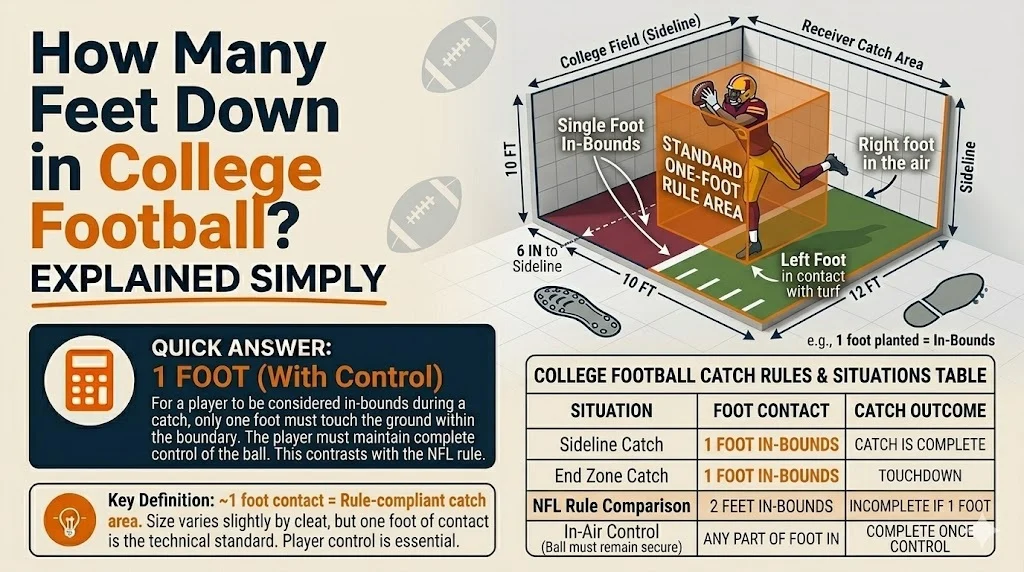
If you are new to college football or switching from watching the NFL, you may ask: how many feet down in college football are required for a catch?
The answer is simple:
1 foot in bounds is required in college football
Under NCAA rules, a receiver only needs one foot down in bounds to complete a legal catch, as long as they also control the football and maintain possession.
This is one of the biggest rule differences between:
- College football
- NFL football
- High school football
In this guide, you will learn the official NCAA catch rule, how catches are judged, examples of completed catches, differences from the NFL, and common misunderstandings.
The Basic College Football Catch Rule
College football has slightly easier catch requirements than the NFL.
One Foot vs Two Feet
In college football:
- One foot in bounds is enough
In the NFL:
- Two feet in bounds are required
This difference often surprises fans who watch both leagues.
NCAA Catch Requirements
For a legal catch in college football, a player must:
- Control the ball
- Get one foot in bounds
- Maintain possession through the catch process
All three elements matter.
Simply touching the ball is not enough.
How Many Feet Must Be Down in College Football?
The official NCAA rule requires:
1 foot down in bounds
A receiver can:
- Place one foot down
- Drag one toe
- Land with any body part in bounds after control
As long as possession is established legally, the catch counts.
Official NCAA Rule Explained
A completed catch generally requires:
- Firm control of the football
- A body part touching in bounds
- Possession maintained long enough to complete the process
An in-bounds body part can include:
- One foot
- One toe
- Knee
- Elbow
- Hand
However, hands alone do not count if they touch first while the player is falling out of bounds.
Why One Foot Is Enough
College football prioritizes game flow and offensive excitement.
Allowing one foot:
- Makes spectacular catches more possible
- Helps offenses move the ball
- Simplifies sideline rulings
It also aligns with many lower football levels, including high school football.
What Counts as a Catch in College Football?
A completed catch involves more than simply getting one foot down.
Control of the Ball
The receiver must clearly secure the football.
Examples of control include:
- Grasping firmly
- Pinning the ball securely
- Preventing movement
If the ball moves significantly or comes loose, officials may rule it incomplete.
Getting a Foot In Bounds
Once control is established, the receiver needs:
- One foot touching in bounds
This can happen:
- On the sideline
- In the end zone
- During a toe-tap catch
Even a small portion of the foot touching the field counts.
Maintaining Possession
Receivers must hold the ball through contact with the ground.
If the player:
- Falls
- Hits the turf
- Loses control during landing
the pass may be ruled incomplete.
College Football vs NFL Catch Rules
The NCAA and NFL use different standards.
One Foot in NCAA
College football requires:
1 foot in bounds
This makes sideline catches easier.
Two Feet in the NFL
NFL rules require:
2 feet in bounds
Receivers must:
- Tap both feet
- Drag toes carefully
- Maintain possession
NFL catches are generally harder to complete near boundaries.
Key Differences
| Rule | College Football | NFL |
|---|---|---|
| Feet required | 1 foot | 2 feet |
| Sideline catches | Easier | Harder |
| Offensive advantage | Higher | Lower |
| Toe-tap difficulty | Moderate | Greater |
Examples of Legal College Football Catches
Real-world examples make the rule easier to understand.
Sideline Catch Example
A receiver:
- Catches the ball
- Drags one toe in bounds
- Falls out of bounds afterward
Result:
- Catch completed
As long as control existed before stepping out.
End Zone Catch Example
A player:
- Secures the ball
- Lands with one foot in bounds
- Maintains control
Result:
- Touchdown
Only one foot is necessary in NCAA play.
Toe-Tap Catches
College receivers often use toe drags near the sideline.
Even minimal contact counts if:
- The toe touches green turf
- Possession is controlled
Replay reviews frequently check these plays closely.
Common Situations That Cause Confusion
Some catch scenarios are harder to judge.
Falling to the Ground
If a receiver is falling while catching:
- They must survive contact with the ground
Losing the ball during landing usually means:
- Incomplete pass
Bobbling the Ball
A receiver may initially touch the pass but not fully control it.
The catch only starts once:
- Possession is secured
Then the player must get a body part down in bounds.
Out-of-Bounds Contact
If the receiver:
- Steps on the sideline
- Lands completely out of bounds
before establishing possession, the pass is incomplete.
Why the NCAA Uses One Foot Down
The NCAA rule creates:
- Faster gameplay
- More offense
- Exciting sideline catches
College football traditionally favors:
- High scoring
- Wide-open offenses
- Athletic plays
The one-foot rule supports that style.
It also reduces the difficulty for younger athletes transitioning from high school football.
Common Misunderstandings About College Football Catch Rules
Many fans misunderstand NCAA catch rules.
Myth: Both Feet Are Always Required
This is false in college football.
Only:
- One foot
- Or another body part
must touch in bounds.
Myth: Toe Drags Don’t Count
Toe taps absolutely count if:
- Control exists
- The toe touches in bounds
Myth: The Ball Cannot Move
Minor movement is allowed.
The key issue is whether:
- Possession remains secure
Officials look for clear control throughout the catch process.
Expert Tips for Understanding Catch Reviews
Replay reviews focus on several key elements.
Watch the Receiver’s Hands
Officials first check:
- Ball control
- Timing of possession
Look at the Feet Carefully
Replay angles zoom in to determine:
- Whether the foot touched in bounds
- Whether the sideline was contacted
Pay Attention to Ground Contact
Many catches become incomplete because:
- The receiver loses the ball while falling
The “survive the ground” rule remains important.
FAQs
1. How many feet have to be down in college football?
College football requires:
1 foot in bounds
for a completed catch.
2. Is college football different from the NFL?
Yes. NCAA rules require one foot down, while NFL rules require two feet down.
3. Does a toe count as a foot in college football?
Yes. A toe touching in bounds counts as a legal foot down.
4. Can a player fall out of bounds after one foot touches?
Yes, if:
- The player controls the ball
- Gets one foot in bounds
- Maintains possession through the catch
5. What happens if the ball moves during the catch?
Minor movement is allowed, but losing clear control may result in an incomplete pass.
Conclusion
So, how many feet down in college football are required for a catch?
The NCAA rule is simple:
1 foot in bounds is enough for a legal catch
As long as the receiver:
- Controls the football
- Gets one foot or body part in bounds
- Maintains possession
the catch is complete.
This one-foot rule is one of the biggest differences between college football and the NFL, making NCAA games more offense-friendly and allowing for exciting sideline catches.
Understanding the rule helps fans follow replay reviews, appreciate difficult catches, and enjoy the strategy and athleticism of college football even more.If you are new to college football or switching from watching the NFL, you may ask: how many feet down in college football are required for a catch?
The answer is simple:
1 foot in bounds is required in college football
Under NCAA rules, a receiver only needs one foot down in bounds to complete a legal catch, as long as they also control the football and maintain possession.
This is one of the biggest rule differences between:
- College football
- NFL football
- High school football
In this guide, you will learn the official NCAA catch rule, how catches are judged, examples of completed catches, differences from the NFL, and common misunderstandings.
Discover More Articles
How Many Square Feet Is a Master Bathroom?