

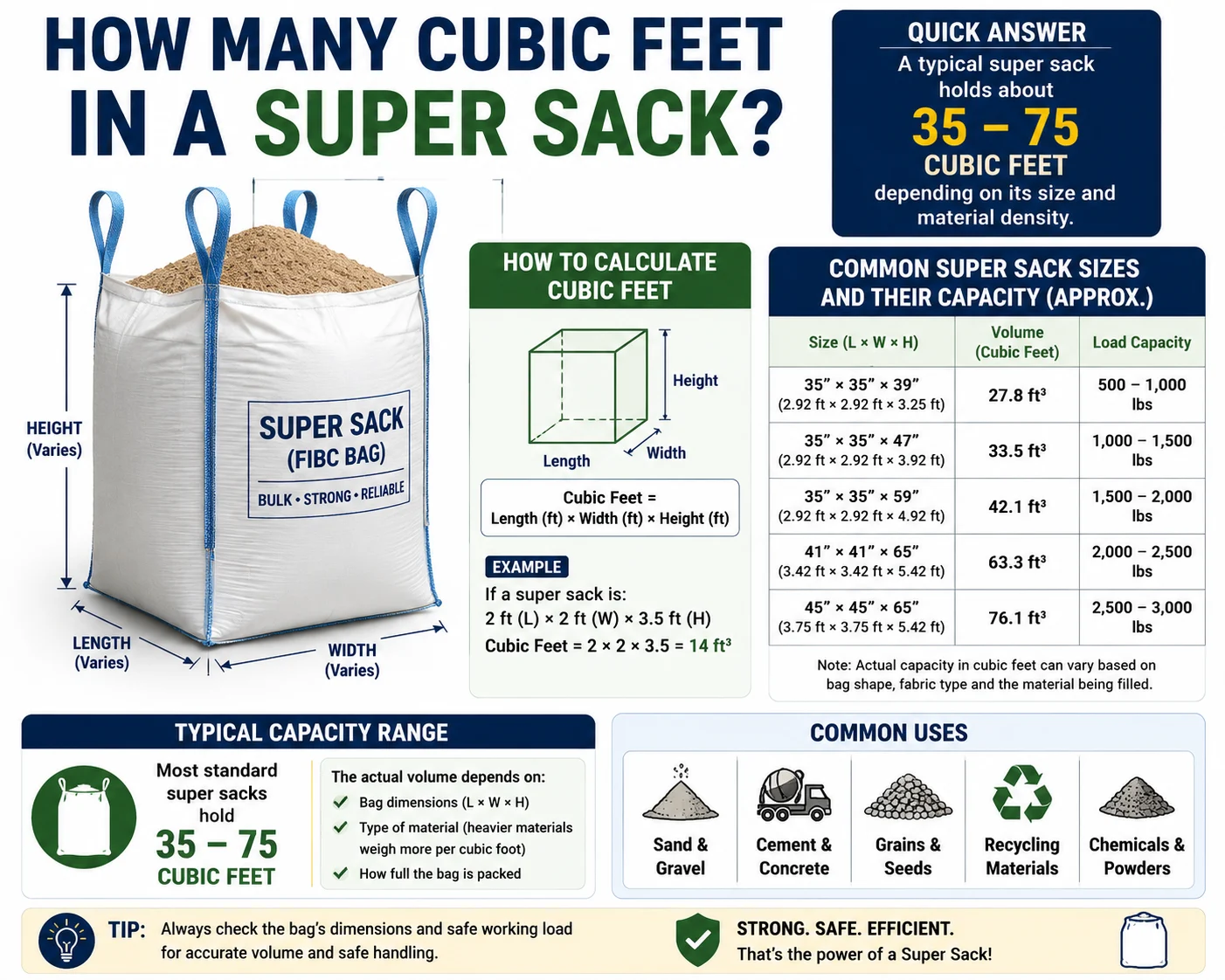
If you’re asking how many cubic feet in a super sack, you’re probably working with construction materials, landscaping supplies, or bulk storage products.
Super sacks are widely used for transporting and storing materials like sand, gravel, mulch, soil, and concrete mix. Understanding their volume helps with planning, transportation, and material estimation.
Let’s break it down in a simple and practical way.
Understanding What a Super Sack Is
Definition of a Super Sack
A super sack is a large industrial bulk bag, also known as a:
- Bulk bag
- FIBC bag (Flexible Intermediate Bulk Container)
These bags are designed to hold heavy materials safely.
Common Uses
Super sacks are commonly used for:
- Sand and gravel
- Soil and mulch
- Cement and concrete mix
- Agricultural products
How Many Cubic Feet in a Super Sack (Exact Answer)
Standard Capacity
Most standard super sacks hold:
35 to 40 cubic feet
However, the exact amount depends on:
- Bag dimensions
- Material density
- Manufacturer specifications
Size Variations
Some larger super sacks may hold:
- 45 cubic feet or more
Smaller sacks may hold:
- Around 30 cubic feet
Super Sack Size Chart
| Super Sack Type | Approx. Cubic Feet |
|---|---|
| Small | 30 cu ft |
| Standard | 35–40 cu ft |
| Large | 45+ cu ft |
This chart helps estimate storage capacity quickly.
Materials Commonly Stored in Super Sacks
Sand
Heavy but compact material.
Mulch
Takes more space because it is lightweight.
Gravel
Dense material with higher weight per cubic foot.
Soil
Often sold in standard super sack quantities.
How to Calculate Cubic Feet in a Super Sack
Formula
Length × Width × Height = Cubic Feet
Example:
- 3.5 ft × 3.5 ft × 3 ft
= 36.75 cubic feet
Why Measurements Matter
Different bag sizes create different capacities.
Real Life Examples
Landscaping Project
A standard super sack of mulch may cover a large garden area.
Construction Site
Builders often use super sacks for sand and aggregate delivery.
Warehouse Storage
Bulk products are easier to move and stack in super sacks.
Why Cubic Feet Matter
Material Estimation
Helps determine how much material you need.
Transportation Planning
Important for truck and trailer loading.
Cost Calculations
Bulk pricing is often based on volume.
Common Mistakes
Confusing Weight With Volume
Heavy materials may take less space but weigh more.
Assuming All Bags Are Same Size
Super sacks vary by manufacturer.
Ignoring Material Density
Different materials fill space differently.
Expert Tips
Check Manufacturer Specs
Always verify exact bag dimensions.
Calculate Before Ordering
Avoid overbuying or shortages.
Understand Material Density
Mulch, sand, and gravel all behave differently.
Plan Storage Space
Super sacks require significant room.
FAQs
How many cubic feet in a super sack?
Most standard super sacks hold 35 to 40 cubic feet
Are all super sacks the same size?
No, sizes vary by manufacturer and purpose
What materials go in super sacks?
Sand, gravel, mulch, soil, cement, and more
How do I calculate cubic feet?
Multiply length × width × height
Does weight affect cubic feet?
No, cubic feet measures volume, not weight
Conclusion
So, how many cubic feet in a super sack? The typical answer is:
About 35 to 40 cubic feet for a standard super sack
However, exact capacity depends on the bag size and material type. Understanding cubic feet helps you estimate storage needs, transportation requirements, and project material quantities more accurately.