
If you are planning a concrete project, one of the most common questions is: how many square feet per bag of concrete can you cover?
The answer depends on two main factors:
- The size of the concrete bag
- The thickness of the concrete pour
For example, a standard 80-pound bag of concrete covers approximately:
4 square feet at 2 inches thick
At a thicker 4-inch slab depth, the same bag covers closer to:
2 square feet
Understanding concrete coverage is important for:
- Patios
- Sidewalks
- Driveways
- Fence posts
- Slabs
- Footings
- DIY repairs
In this guide, you will learn how many square feet different concrete bags cover, how slab thickness changes coverage, practical examples, and expert tips for accurate estimation.
Understanding Concrete Coverage
Concrete coverage refers to how much surface area a bag of concrete can fill at a certain thickness.
Why Coverage Depends on Thickness
Concrete is measured by volume, not just area.
A thinner slab covers more square feet, while a thicker slab covers less area because it uses more material.
For example:
- A 2-inch slab spreads farther
- A 6-inch slab uses much more concrete
That is why depth matters in every calculation.
Common Bag Sizes
Concrete mix is commonly sold in:
- 40-pound bags
- 50-pound bags
- 60-pound bags
- 80-pound bags
Larger bags produce more concrete and cover more area.
Approximate concrete yields:
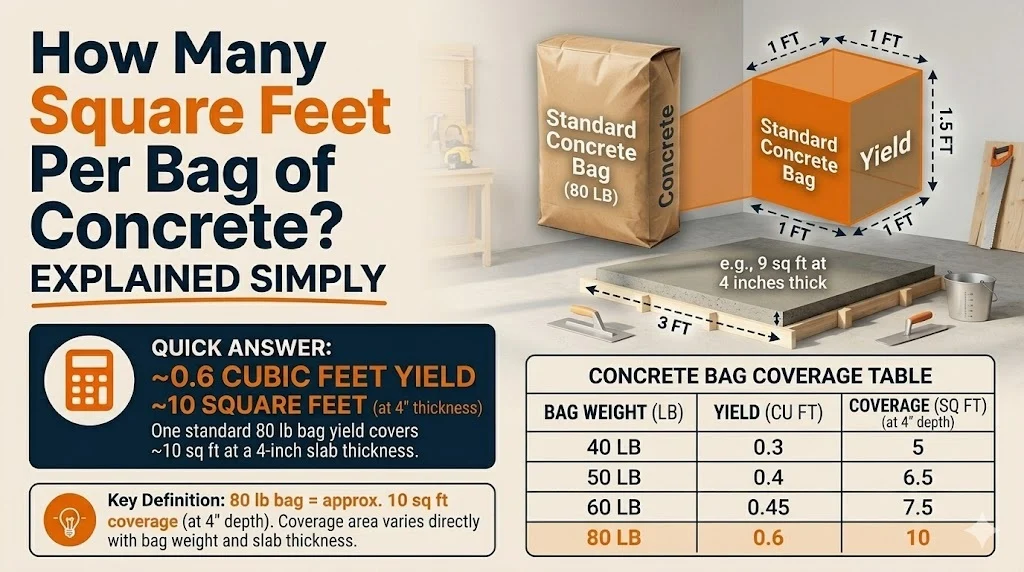
| Bag Size | Yield |
|---|---|
| 40 lb | 0.30 cubic feet |
| 50 lb | 0.37 cubic feet |
| 60 lb | 0.45 cubic feet |
| 80 lb | 0.60 cubic feet |
How Many Square Feet Does a Bag of Concrete Cover?
Coverage varies by slab thickness.
40 lb Bag Coverage
A 40-pound bag yields about:
0.30 cubic feet
Coverage estimates:
- About 1.8 sq ft at 2 inches thick
- About 0.9 sq ft at 4 inches thick
Best for:
- Small repairs
- Fence posts
- Patch work
50 lb Bag Coverage
A 50-pound bag yields approximately:
0.37 cubic feet
Coverage estimates:
- Around 2.2 sq ft at 2 inches
- Around 1.1 sq ft at 4 inches
Suitable for:
- Small slabs
- Stepping stones
- Minor repairs
60 lb Bag Coverage
A 60-pound bag yields:
0.45 cubic feet
Coverage:
- About 2.7 sq ft at 2 inches
- About 1.35 sq ft at 4 inches
Good for:
- Sidewalk sections
- Patio repairs
- Footings
80 lb Bag Coverage
An 80-pound bag produces roughly:
0.60 cubic feet
Coverage:
- About 4 sq ft at 2 inches
- About 2 sq ft at 4 inches
- About 1.3 sq ft at 6 inches
This is the most commonly used bag size for larger projects.
Concrete Coverage Chart by Bag Size
The chart below shows approximate concrete coverage.
Coverage at 2 Inches Thick
| Bag Size | Approximate Coverage |
|---|---|
| 40 lb | 1.8 sq ft |
| 50 lb | 2.2 sq ft |
| 60 lb | 2.7 sq ft |
| 80 lb | 4 sq ft |
Coverage at 4 Inches Thick
| Bag Size | Approximate Coverage |
|---|---|
| 40 lb | 0.9 sq ft |
| 50 lb | 1.1 sq ft |
| 60 lb | 1.35 sq ft |
| 80 lb | 2 sq ft |
Coverage at 6 Inches Thick
| Bag Size | Approximate Coverage |
|---|---|
| 40 lb | 0.6 sq ft |
| 50 lb | 0.75 sq ft |
| 60 lb | 0.9 sq ft |
| 80 lb | 1.3 sq ft |
These estimates may vary slightly by manufacturer.
How to Calculate Concrete Coverage
Calculating coverage yourself is simple.
Formula Explained
Use this formula:
Coverage=Thickness in FeetConcrete Yield
First, convert slab thickness into feet.
Thickness Conversion Chart
| Inches | Feet |
|---|---|
| 2 inches | 0.167 ft |
| 4 inches | 0.333 ft |
| 6 inches | 0.5 ft |
Step-by-Step Example
Suppose you use an 80-pound bag with a yield of 0.60 cubic feet at 4 inches thick.
Convert thickness:
4 inches=0.333 feet
Now calculate:
0.3330.60≈1.8 sq ft
Rounded up, coverage is about 2 square feet.
Real-World Concrete Calculation Examples
Practical examples make estimating easier.
Sidewalk Example
Suppose your sidewalk measures:
- 20 feet long
- 3 feet wide
- 4 inches thick
Area:
20×3=60 sq ft
An 80-pound bag covers about 2 sq ft at 4 inches.
Bags needed:
260=30
You need roughly 30 bags.
Patio Example
Patio dimensions:
- 12 feet by 12 feet
- 4 inches thick
Area:
12×12=144 sq ft
Bags needed:
2144=72
You need approximately 72 bags of 80-pound concrete.
Fence Post Example
Fence hole dimensions:
- 1 foot diameter
- 2 feet deep
A single 80-pound bag usually fills most standard fence post holes.
Always verify hole dimensions before purchasing.
Factors That Affect Concrete Coverage
Actual coverage often differs slightly from estimates.
Thickness
Thicker slabs dramatically reduce coverage.
For example:
- 2-inch slab = more area
- 6-inch slab = much less area
Waste and Spillage
Concrete projects usually involve some waste due to:
- Spills
- Mixing errors
- Uneven forms
- Ground absorption
Professionals often add:
- 5% extra for small jobs
- 10% extra for large pours
Uneven Ground
Uneven surfaces may require more concrete to maintain consistent slab thickness.
Always account for low spots.
Common Mistakes When Estimating Concrete
Small calculation mistakes can become expensive.
Forgetting Depth Conversion
One of the biggest errors is failing to convert inches into feet before calculations.
Always convert properly.
Buying Too Few Bags
Running out of concrete during a pour can:
- Delay work
- Create weak joints
- Affect slab quality
Extra material is safer than shortages.
Ignoring Waste Factor
Exact calculations rarely match real-world conditions perfectly.
Buying slightly extra reduces stress.
Expert Tips for Accurate Concrete Estimation
Professionals recommend several best practices.
Measure Carefully
Double-check:
- Length
- Width
- Depth
Accurate measurements improve estimates.
Buy Slightly Extra
A few extra bags prevent project interruptions.
Unused bags can often be stored if kept dry.
Use Larger Bags for Big Projects
80-pound bags reduce:
- Bag count
- Mixing time
- Labor
Consider Ready-Mix Concrete
For large slabs, ready-mix concrete may be cheaper and easier than mixing dozens of bags.
FAQs
1. How many square feet does an 80-pound bag of concrete cover?
An 80-pound bag covers approximately:
- 4 sq ft at 2 inches thick
- 2 sq ft at 4 inches thick
2. How many 80-pound bags of concrete make a yard?
One cubic yard equals about:
45 bags of 80-pound concrete
3. Why does slab thickness affect coverage?
Thicker concrete uses more volume, reducing the total area covered.
4. Should I buy extra concrete bags?
Yes. Most experts recommend adding 5% to 10% extra for waste and uneven surfaces.
5. How do I calculate concrete coverage?
Use this formula:
Area=ThicknessConcrete Yield
Conclusion
So, how many square feet per bag of concrete can you expect?
The answer depends mainly on:
- Bag size
- Slab thickness
A standard 80-pound bag generally covers:
2 square feet at 4 inches thick
Understanding concrete coverage helps you:
- Estimate projects accurately
- Avoid shortages
- Reduce waste
- Save money
By using proper calculations, accounting for slab thickness, and adding a small waste factor, you can confidently plan concrete projects ranging from sidewalks and patios to slabs and fence posts.
Discover More Articles
How Many Cubic Feet in a Super Sack