
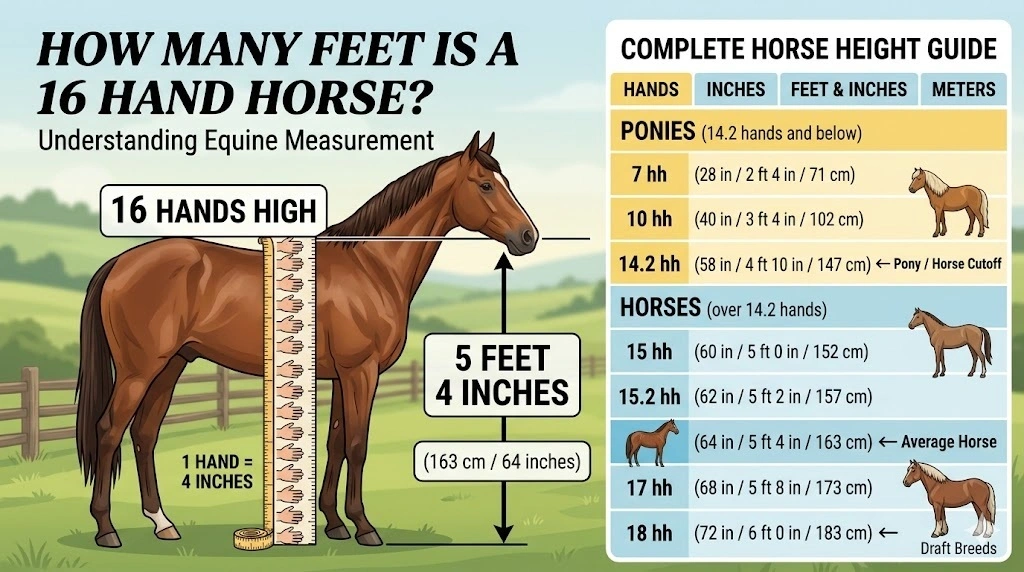
If you are wondering how many feet is a 16 hand horse, the answer is:
16 hands=64 inches
Since there are:
12 inches=1 foot
a 16 hand horse stands approximately:
64÷12≈5.3 feet
or:
- 5 feet 4 inches tall
Horse height is traditionally measured using:
- Hands
rather than feet or inches.
This unique system has been used for centuries in:
- Equestrian sports
- Horse breeding
- Stable management
- Competitive riding
In this complete guide, you will learn how horse height measurements work, how hands convert into feet, how horses are measured properly, and what breeds commonly stand around 16 hands tall.
Quick Answer
A 16 hand horse measures:
64 inches
which equals approximately:
5 feet 4 inches
at the withers.
What Does “Hands” Mean in Horse Measurement?
In the horse world, height is measured in:
- Hands
One Hand Equals Four Inches
Officially:
1 hand=4 inches
This measurement system dates back hundreds of years.
Why Horses Use Hands Instead of Feet
The “hand” system became popular because:
- It was simple
- Easy to estimate
- Standardized for horse trading
How to Convert 16 Hands Into Feet
The conversion process is simple.
Step 1: Convert Hands to Inches
Multiply hands by four:
16×4=64 inches
Step 2: Convert Inches to Feet
Divide inches by twelve:
64÷12=5.33 feet
Final height:
- Approximately 5 feet 4 inches
Where Is a Horse Measured?
Horses are measured at the:
- Withers
What Are the Withers?
The withers are:
- The highest point of a horse’s shoulders
This provides a consistent measurement point because:
- Head position changes frequently
Is a 16 Hand Horse Tall?
Yes. A 16 hand horse is considered:
- Fairly tall
for most riding horses.
Average Riding Horse Height
Most riding horses range between:
14 to 17 hands
Comparison to Humans
A 16 hand horse stands:
- Taller than many adults at the shoulder
with the horse’s head extending much higher.
Common Horse Breeds Around 16 Hands
Many popular horse breeds commonly reach:
- 16 hands
Thoroughbreds
Thoroughbreds often stand:
- 15.5 to 17 hands
Warmbloods
Warmblood breeds used in:
- Dressage
- Jumping
are frequently around:
- 16 to 17 hands
Quarter Horses
Some larger Quarter Horses reach:
- Around 16 hands
Horse Height Chart
Here is a quick horse height conversion chart.
| Hands | Inches | Approximate Feet |
|---|---|---|
| 14 hands | 56 inches | 4 ft 8 in |
| 15 hands | 60 inches | 5 ft |
| 16 hands | 64 inches | 5 ft 4 in |
| 17 hands | 68 inches | 5 ft 8 in |
| 18 hands | 72 inches | 6 ft |
How to Measure a Horse Correctly
Accurate horse measurements are important for:
- Competitions
- Buying horses
- Saddle fitting
Step 1: Place Horse on Flat Ground
The horse should stand:
- Evenly
- Calmly
Step 2: Measure at the Withers
Use:
- A horse measuring stick
or - Measuring tape
Step 3: Record the Height
Measurements are usually written in:
- Hands and inches
Example:
- 16.2 hands
means:
- 16 hands and 2 inches
Understanding Horse Height Notation
Horse heights often include decimals.
Example: 16.2 Hands
This does NOT mean:
- 16.2 × 4 inches
Instead:
- The number after the decimal represents inches
So:
16.2 hands=16 hands +2 inches
Total height:
66 inches
Why Horse Height Matters
Horse size affects:
- Riding comfort
- Performance
- Training
- Equipment fit
Rider Matching
Larger riders may prefer:
- Taller horses
Discipline Requirements
Different riding sports favor different heights.
For example:
- Jumpers are often taller
- Barrel racers may be more compact
Trailer and Stable Size
Horse height affects:
- Stall dimensions
- Trailer clearance
Advantages of a 16 Hand Horse
Many riders consider 16 hands an ideal size.
Balanced Height
A 16 hand horse offers:
- Good athletic ability
- Comfortable riding position
Versatility
This size works well for:
- Trail riding
- Jumping
- Dressage
- General riding
Strong Presence
Larger horses often appear:
- Elegant
- Powerful
Common Myths About Horse Height
Taller Horses Are Always Better
Not necessarily.
Horse suitability depends on:
- Temperament
- Training
- Rider compatibility
Bigger Horses Run Faster
Speed depends on:
- Breed
- Conditioning
- Genetics
not just height.
Fun Facts About Horse Measurements
The “Hand” Measurement Is Ancient
The system dates back:
- Hundreds of years
Some Draft Horses Exceed 18 Hands
Massive draft breeds can stand:
- Over 6 feet tall at the withers
Ponies Are Classified by Height
Equines under a certain height are classified as:
- Ponies
rather than horses.
FAQs
How many feet is a 16 hand horse?
A 16 hand horse stands approximately:
5 feet 4 inches
How many inches is 16 hands?
Sixteen hands equals:
64 inches
Is a 16 hand horse considered tall?
Yes. A 16 hand horse is considered:
- Moderately tall
for riding horses.
What does 16.2 hands mean?
It means:
- 16 hands and 2 inches
not a decimal measurement.
Where do you measure a horse?
Horses are measured at:
- The withers
the highest point of the shoulders.
Conclusion
So, how many feet is a 16 hand horse? The height converts to approximately:
5 feet 4 inches
or:
64 inches
Horse height measurements using hands remain an important part of equestrian culture, breeding, competition, and horse ownership.
Whether you are buying a horse, learning about equestrian terminology, or comparing horse breeds, understanding hand-to-feet conversions makes horse sizing much easier to understand.